
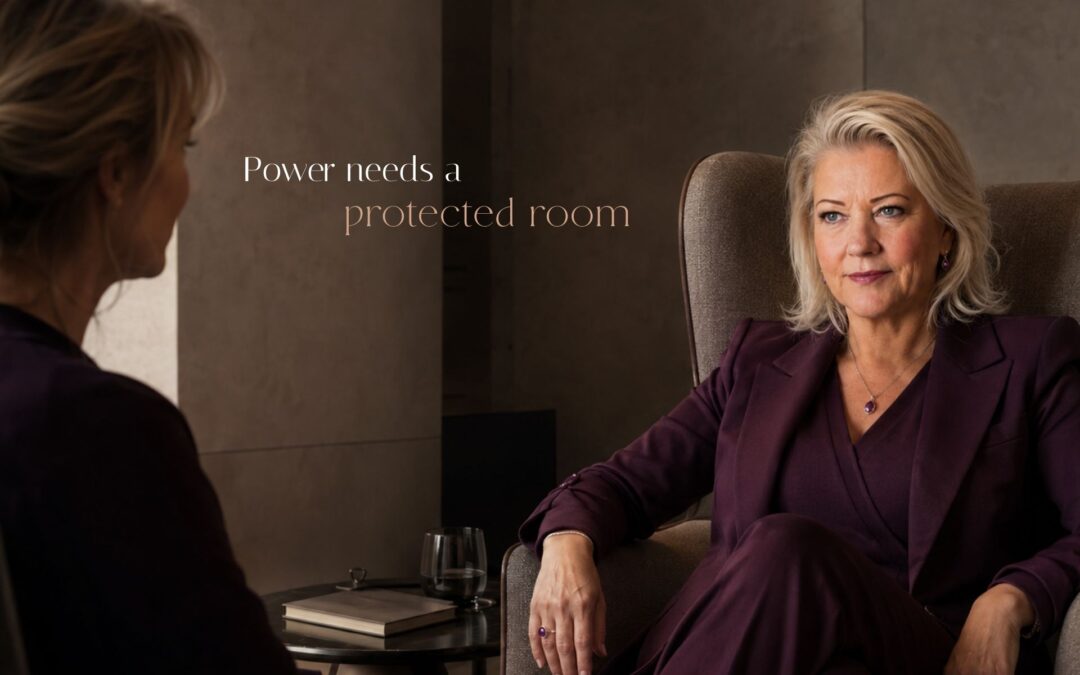
Female Power Needs Space
Why the strongest advisory relationships begin long before a crisis
When responsibility has nowhere to go
For many people, advisory support begins when a situation has already become difficult. When a crisis emerges, a conflict escalates, a decision has been postponed for too long, or its consequences suddenly feel heavier than expected.
Advice then becomes something we seek when other options have been exhausted. A last resort, an intervention, an emergency exit we only begin to consider once the pressure has become too great.
Yet the strongest advisory relationships often begin much earlier.
They grow out of an understanding of what responsibility does to a person, rather than a moment of overwhelm.
This matters particularly where decisions can no longer be delegated and where being objectively right is not enough.
The greater the responsibility, the less a decision is simply about identifying the most sensible option. It also requires the person making it to maintain enough inner clarity to carry the consequences, tolerate contradictions, and resist the narrowing of perspective that can occur under pressure.
Complexity needs to be analysed, but it also needs to be carried internally.
A protected space for reflection is therefore more than support offered after difficulties arise. It belongs to the inner architecture that prevents responsibility from becoming isolation.
Why female power requires more than strength
Female power is not a slogan. It is the capacity to shape outcomes while carrying responsibility.
It is expressed through visibility, influence and the ability to assert oneself, but its deeper significance becomes apparent when a woman must carry the consequences of her decisions. When she has to act without complete certainty, remain visible under institutional pressure, and preserve her integrity in circumstances where no one else can assume that responsibility for her.
Women in senior leadership often have to reconcile expectations that are difficult to satisfy simultaneously. They are expected to be strategically clear and emotionally controlled, resilient and principled, empathetic and assertive, collaborative and independent in their judgement. They must lead without appearing too forceful, listen without surrendering authority, and make decisions without losing the confidence of their teams. They are expected to be visible, but not to occupy too much space.
This goes beyond a demanding leadership role. It is a persistent double standard that requires women to absorb contradictions, reconcile competing expectations, and make an almost impossible balance appear effortless.
No one can sustain such demands indefinitely without paying an internal price.
Eventually, strength alone is no longer sufficient. Strength can become armour. Control can begin to restrict rather than support. Even clarity can become isolating when there is nowhere to examine one’s thinking without distortion.
Female power therefore needs more than resilience. It needs an inner structure that remains flexible and reliable under pressure rather than becoming increasingly rigid.
This is where the role of a Trusted Advisor acquires its deeper meaning.
I do not see it as another business title or a fashionable term for consulting. I see it as a confidential counterpart for women carrying considerable responsibility, someone with whom they do not need to demonstrate their power or immediately turn every concern into a solution.
Such a relationship gives a woman the opportunity to examine what she is actually carrying before she has to return to the outside world with clarity and authority.
The old structures of power understood this
Those who exercised power throughout history understood something that modern leadership often overlooks:
Responsibility requires reflection.
People who hold power are rarely without others around them, yet they can be profoundly isolated. Power attracts interests, expectations, dependencies, loyalties and projections. The higher someone rises, the fewer genuinely neutral spaces remain available.
This is a structural reality rather than simply a personal difficulty.
Ruling elites, political institutions, business families, established wealth, corporate boards and founders have long maintained confidential circles around those who make consequential decisions. Advisors, confidants, mentors, spiritual counsellors and strategic counterparts have occupied positions outside the public exercise of authority while helping those in power examine their perceptions, judgement and conduct.
Seeking such counsel was rarely regarded as weakness. It was part of the architecture of power itself.
Power without an independent space for reflection can become dangerous.
Isolation can distort perception. Unspoken tensions accumulate. Loyalties shift without being examined, and unresolved internal contradictions can become increasingly difficult to acknowledge. Over time, responsibility that cannot be reflected upon begins to affect the person who carries it.
Geopolitical crises make the consequences of power without independent reflection particularly visible. When decisions are shaped by time pressure, public expectations, military considerations, personal ego and historical grievances, access to information alone is insufficient. Strategy matters, but so does the quality of the environment in which those exercising power examine their own thinking.
Leadership attracts attention. Decisions create competing interests. Authority makes a person the subject of other people’s expectations and projections. And those who carry the consequences of decisions cannot necessarily discuss every concern with the people affected by them.
Power has always needed spaces beyond the immediate exercise of power.
Spaces where perceptions can be examined without immediately becoming political. Where doubt is not interpreted as weakness and where internal tensions can be acknowledged before they influence external decisions.
Modern leadership has professionalised almost everything around responsibility: processes, governance, compliance, reporting, strategy and communication. Yet the confidential space available to the person who must integrate all these demands often remains surprisingly underdeveloped.
A space beyond the demands of responsibility
Women carrying significant responsibility frequently seek support first in their existing relationships: with partners, friends, trusted colleagues or people in their professional environment.
This is natural and often emotionally necessary.
But these relationships are rarely free of their own interests and expectations. Partners are emotionally involved. Friends bring personal perspectives and assumptions. Teams have expectations, boards have interests, employees need stability, and professional peers may also be competitors.
The possibility of speaking without reservation can therefore disappear even when a woman is surrounded by people who care about her.
Almost every existing relationship already carries some combination of loyalty, affection, concern, expectations, competing interests or power.
A confidential advisory relationship offers something different.
It provides a place where a woman does not first have to justify why something feels difficult. She can examine precisely what she is carrying and what the situation requires of her.
A woman in senior leadership is rarely concerned only with identifying the right decision. Her questions often reach further.
How can she protect her team without shielding people from responsibilities they need to assume themselves? What can she reasonably ask of others? Where does care end and the obligation to let others carry their own responsibilities begin?
How should she decide when the financial evidence, her intuition, her loyalties and her sense of responsibility point in different directions? Can she trust her own judgement, or is she seeking relief from a decision whose consequences she knows she must carry?
Such questions do not arise from a lack of ability.
They arise because responsibility is a human experience as well as an intellectual and professional task.
This is why a protected space becomes valuable long before a crisis occurs.
Many crises do not begin with an obvious external event. They develop internally through a gradual narrowing of perspective, unresolved uncertainty, and the growing tension between what a woman knows, what she feels, and what the organisation expects of her.
The dimension beneath expertise
This is where I place the work of a Trusted Advisor.
It does not replace specialist advice. Strategy, legal counsel, governance, finance, communication and restructuring all require their own expertise. In complex situations, such expertise is indispensable.
But every piece of advice must ultimately be interpreted and acted upon by a human being.
A report does not make a decision. An analysis does not carry its consequences. A strategy does not produce results independently of the people responsible for implementing it. A resolution may change the circumstances, but someone must live with what follows.
This is the dimension in which my work takes place: with the woman who must bring together different forms of expertise, hold competing considerations, assess consequences and ultimately take responsibility for a decision.
My approach to Trusted Advisory is not about adding another specialist opinion. It is about strengthening the inner coherence of the woman who must integrate all those opinions, tensions and consequences.
The protected space
Our work together creates a protected space that is confidential, precise and sufficiently calm to accommodate what often has no place in the formal environment of leadership.
Its purpose is not to withdraw from responsibility. It is to create conditions in which responsibility can once again be exercised with full awareness.
A woman does not have to perform competence every moment she is there. She need not appear composed before she has even found the words for what is troubling her. She does not have to prove her strength or rush towards an orderly explanation simply because others expect her to have answers.
In such a space, thinking can regain its depth.
She can speak about matters that have no place in official conversations. She can distinguish what belongs to her from what belongs to the organisation. She can attend to her own perceptions before acting, examine her assumptions before deciding, and recognise where her responsibility lies and where she has begun carrying responsibilities that are no longer hers.
This is not a luxury in any superficial sense.
It is a form of strategic self-preservation.
Female power does not diminish when it has a protected space for reflection. It becomes more sustainable, more flexible, more discerning and less reactive. Above all, the woman exercising it is no longer left to carry everything alone.
A protected space is therefore not an optional addition to leadership. It is part of the architecture that helps responsibility remain sustainable, long before a difficult situation becomes a visible crisis.
Long before the crisis
A Trusted Advisor is not an emergency exit.
The relationship belongs to an approach to responsibility that begins earlier, while there is still time and room to shape what happens next.
The strongest advisory relationships develop when a woman takes seriously the weight of what she carries. When she understands that responsibility must be exercised externally and integrated internally. And when she recognises that isolation is not a professional achievement, nor is strength measured by the ability to endure everything alone.
Working consciously with a Trusted Advisor is an expression of professional care and sound judgement.
It creates an appropriate space for what must be considered, decided and carried, while genuine possibilities for action still exist.
🌳 Orchard Letter 25
If this letter has resonated with you or opened a new line of thought, I invite you to remain part of the Orchard, a space where questions of power, responsibility and inner leadership continue to be explored.
I work with women carrying significant responsibility, whose decisions reach well beyond their immediate sphere of influence. Our work creates a confidential space in which perception, judgement and inner authority can be brought back into alignment.
A complimentary Power Talk is a first step into this space: a focused, confidential conversation to explore a situation that calls for clarity, perspective or a deeper understanding of what is at stake.
About the Author
Renate Hechenberger brings together 30 years of international leadership experience, including 20 years in senior corporate positions, and more than 15 years of spiritual and energetic work exploring inner authority, power and responsibility.
As a Female Power Architect and Trusted Advisor, she works with women who carry influence and significant responsibility. Her approach combines strategic clarity with energetic awareness and spiritual depth.
© 2026 Renate Hechenberger. All rights reserved.


 powered by Borlabs Cookie